




About $168 billion in multifamily loans is scheduled to come due in 2027 ( CoStar, citing MMG Real Estate Advisors), and the MBA expects the 10-year Treasury to stay near 5% through the year ( HousingWire). With rates staying high, lenders are underwriting harder, and the right loan structure decides whether your apartment deal cash-flows or stalls.
This guide covers how multifamily loans work, your six main loan options, current rates and the 2027 outlook, how lenders calculate rental income, which lender fits your deal, and a step-by-step plan to get funded.
Table of contents
1. How do multifamily loans work?
1.1 What lenders look at to approve a multifamily loan
1.2 How lenders decide your loan amount (LTV and DSCR)
1.3 Do 1-4 unit properties count as multifamily?
2. Loan options for buying a multifamily property
2.1 Agency loans (Fannie Mae and Freddie Mac)
2.2 HUD/FHA 223(f) loans
2.3 Bank and credit union loans
2.4 CMBS loans
2.5 Bridge loans
2.6 Asset-based term loans
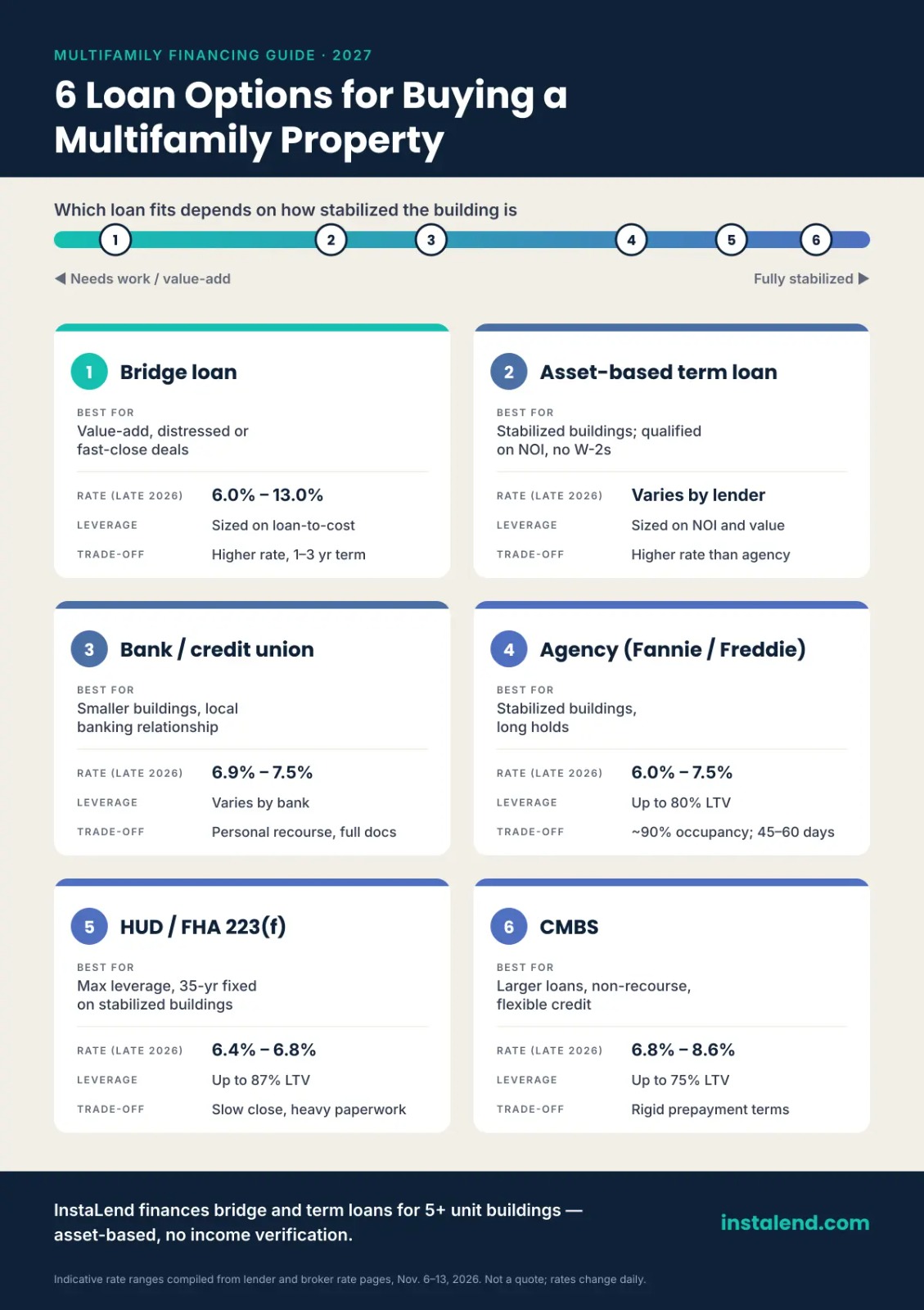
2.7 Side-by-side comparison of multifamily loan options
3. Multifamily loan rates heading into 2027
3.1 Current multifamily loan rates by loan ty pe
3.2 What affects your multifamily loan rate
3.3 Why large apartment complex loans often get lower rates
3.4 What to expect for multifamily loans in 2027
4. How lenders calculate rental income
4.1 Lenders start with the rent roll
4.2 Lenders subtract vacancy and lost rent
4.3 Lenders subtract operating expenses to find NOI
4.4 Lenders check that NOI covers the loan payment (DSCR)
5. Types of multifamily lenders and how to choose one
5.1 Which type of lender is best for your deal?
5.2 Questions to ask before choosing a multifamily lender
6. Where InstaLend fits
7. FAQs
8. Your step-by-step plan to finance a multifamily property
1. How do multifamily loans work?
A multifamily loan is secured by a 5+ unit apartment building and repaid from its rent. The lender's main question is whether the building can carry the debt, not whether your salary can.
1.1 What lenders look at to approve a multifamily loan
Net operating income (NOI): Rental income minus operating expenses (taxes, insurance, maintenance, management), before loan payments.
Occupancy: How much of the building is leased and paying rent today.
Property condition: Deferred maintenance or major repairs can shrink the loan or rule out permanent lenders.
Market value: An appraisal sets the value the loan is measured against.
Your profile: Banks and agency lenders review your net worth, liquidity, credit and experience.
Asset-based option: Lenders like InstaLend qualify the loan on the property's income and value, with no W-2s or tax returns. For the full checklist, see how multifamily lenders evaluate properties.
1.2 How lenders decide your loan amount (LTV and DSCR)
Loan-to-value (LTV): Caps the loan at a share of the appraised value, often up to 75% to 80%.
Debt service coverage ratio (DSCR): NOI divided by annual loan payments; lenders commonly want 1.20x to 1.25x or higher.
Loan-to-cost (LTC): Bridge loans are often sized on purchase price plus renovation budget instead.
The lower number wins: Permanent loans are sized on whichever of LTV or DSCR gives the smaller loan. 2026 reality: With rates high relative to property yields, DSCR usually sets the loan size. See worked examples in how multifamily loan amounts are calculated.
1.3 Do 1-4 unit properties count as multifamily?
Not for commercial lending: duplexes, triplexes and fourplexes usually follow residentialstyle rules. Five units and up is commercial multifamily, qualified on the whole building's NOI ( 1-4 unit vs. 5+ unit financing).
2. Loan options for buying a multifamily property
2.1 Agency loans (Fannie Mae and Freddie Mac)
Fannie Mae and Freddie Mac buy or guarantee loans made by approved lenders. Their 2026 purchase caps are $88 billion each, with at least 50% of business going to affordable housing ( FHFA, Arbor).
-
Pros: Among the lowest long-term fixed rates, up to 80% LTV, mostly non-recourse, up to 30-year amortization.
-
Cons: Typically needs 90% occupancy for about 90 days, strict net worth and liquidity rules, and prepayment penalties.
-
Best For: Stabilized buildings you plan to hold for years.
-
Sweet Spot: Fannie Mae Small Loans, roughly $1 million to $9 million, with a lighter application ( Multifamily.loans).
2.2 HUD/FHA 223(f) loans
HUD/FHA loans are federally insured. The 223(f) program covers buying or refinancing existing apartments; 221(d)(4) covers new construction.
- Pros: Up to 87% LTV and a 1.15x DSCR floor for market-rate properties (NewPoint), plus 35-year fixed, fully amortizing terms (HUD.loans).
- Cons: Often 6 to 10 months to close (FRC Capital), heavy paperwork and an annual mortgage insurance premium.
- Best For: Patient investors who want maximum leverage and a very long fixed rate.
2.3 Bank and credit union loans
Banks and credit unions lend from their own balance sheets. That makes them more flexible on property condition and business plans.
- Pros: Flexible underwriting, relationship pricing and often simpler step-down prepayment terms.
- Cons: Usually personal recourse, shorter fixed periods (commonly 5 to 10 years) and full personal financial documents.
- Best For: Smaller buildings and investors with an existing banking relationship
2.4 CMBS Loans
CMBS lenders pool loans and sell them to bond investors as commercial mortgage-backed securities.
- Pros: Non-recourse, up to about 75% LTV (Select Commercial), and forgiving of borrower credit.
- Cons: Rigid servicing and costly prepayment through defeasance or yield maintenance.
- Best For: Larger loans where you want non-recourse debt.
2.5 Bridge Loans
Bridge loans are short-term loans for buildings that don't qualify for permanent debt yet. You renovate, lease up, then refinance or sell.
- Pros: Closes in days or weeks, interest-only payments, and can fund renovation through loan-to-cost.
- Cons: Higher rates than permanent debt, short 1 to 3 year terms and refinance risk if rents miss the plan.
- Best For: Value-add, distressed or under-occupied buildings, and deals that must close fast.
- With InstaLend: Multifamily bridge loans from $500,000 to $10M+, up to 80% LTC, 12 to 24 months interest-only, closing in 7 to 14 business days.
New to bridge debt? Start with What Is a Multifamily Bridge Loan and When Should You Use One?
2.6 Asset-Based term loans
Asset-based term loans (often called DSCR loans) are long-term loans qualified on the building's cash flow and value. They skip personal tax returns.
- Pros: No W-2s or tax returns, lighter paperwork, and room to scale a portfolio.
- Cons: Rates are generally higher than agency or bank loans (InstaLend).
- Best For: Stabilized 5+ unit buildings, self-employed investors and growing portfolios.
- With InstaLend: Multifamily term loans from $500,000, qualified on NOI and value, targeting 1.20x to 1.25x DSCR.
2.7 Side-by-side comparison ofi multifiamily loan options
|
Loan type |
Max leverage |
Typical term |
Time to close |
Recourse |
Best for |
|
Agency (Fannie/Freddie) |
Up to 80% LTV |
5–30 years |
45–60 days |
Mostly non-recourse |
Stabilized, long hold |
|
HUD/FHA 223(f) |
Up to 87% LTV |
Up to 35 years |
Often 6–10 months |
Non-recourse |
Max leverage, patient borrower |
|
Bank / credit union |
Varies by bank |
Commonly 5–10 years |
Usually faster than agency |
Usually recourse |
Smaller buildings, local investors |
|
CMBS |
Up to ~75% LTV |
5–10 years |
Varies |
Non-recourse |
Larger loans |
|
Bridge (general market) |
Sized on loan-to-cost |
1–3 years |
Days to weeks |
Varies by lender |
Value-add, fast closes |
|
Asset-based term (general market) |
Sized on NOI and value |
Long-term |
Varies by lender |
Varies by lender |
Stabilized, lighter docs |
|
Private lender: InstaLend |
Bridge: up to 80% LTC; term loans: sized on NOI and value |
Bridge: 12–24 months; term loans: long-term |
Bridge: 7– 14 business days |
[CONFIRM WITH INSTALEND] |
Value-add or stabilized 5+ unit buildings, no income verification |
3. Multifiamily loan rates heading into 2027
In mid-November 2026, stabilized apartment loans from agency, HUD, bank and CMBS lenders are mostly quoted between about 6% and 7.5%. Bridge loans run higher because they finance riskier, short-term situations.
3.1 Current multifiamily loan rates by loan type (late 2026)
|
Loan type |
Indicative rate (Nov. 2026) |
Max leverage |
Source |
|
Agency (Fannie/Freddie) |
About 6.0% to 7.5% |
Up to 80% LTV |
|
|
HUD/FHA 223(f) |
About 6.4% to 6.8% |
Up to 87% LTV |
|
|
Bank |
About 6.9% to 7.5% |
Varies by bank |
|
|
CMBS |
About 6.8% to 8.6% |
Up to 75% LTV |
|
|
Life insurance company |
About 6.5% to 9.2% |
Usually lower leverage |
|
|
Bridge (general market) |
About 6.0% to 13.0% |
Sized on loan-to-cost |
|
|
Private lender: InstaLend |
Custom quote per deal |
Bridge: up to 80% LTC; term loans: sized on NOI and value |
3.2 What afifiects your multifiamily loan rate
- Leverage: Lower LTV and higher DSCR usually earn better pricing.
- Occupancy and condition: Stabilized, well-kept buildings price best.
- Loan size: Larger loans often get tighter spreads.
- Market: Major metros usually price better than small or rural markets.
- Structure: Fixed vs. floating, interest-only periods and prepayment terms all move the rate.
- Borrower profile: Experience, liquidity and credit still matter to many lenders.
3.3 Why large apartment complex loans ofiten get lower rates
Bigger loans spread a lender's fixed costs over more dollars and often sit on higher-quality buildings. One broker's Nov. 13, 2026 rates start at 6.02% for agency loans over $6 million, vs. 6.42% under $6 million (Select Commercial).
3.4 What to expect fior multifiamily loans in 2027
Forecasts point to a high-rate year with slowly improving rents. Plan your deal around today's rates, not hoped-for cuts.
- Interest rates: The MBA expects the 10-year Treasury to stay near 5% through 2027 (HousingWire), and it expects two more Fed hikes, one in December and one in early 2027 (National Mortgage News).
- Loan maturities: About $167.7 billion in multifamily loans comes due in 2027, slightly above 2026, so refinance demand stays strong (CoStar).
- Agency capacity: FHFA usually announces the next year's Fannie Mae and Freddie Mac caps in late November; 2026 caps were $88 billion each (FHFA).
 Rent growth: CoStar forecasts 2.6% national rent growth by Q4 2027 (CRE Daily); Yardi Matrix expects 2% to 3% (Connect CRE).
- What it means for you: With rates near 5% on the 10-year, DSCR will usually cap your loan size, so value-add plans should assume modest rent growth.
4. How lenders calculate rental income
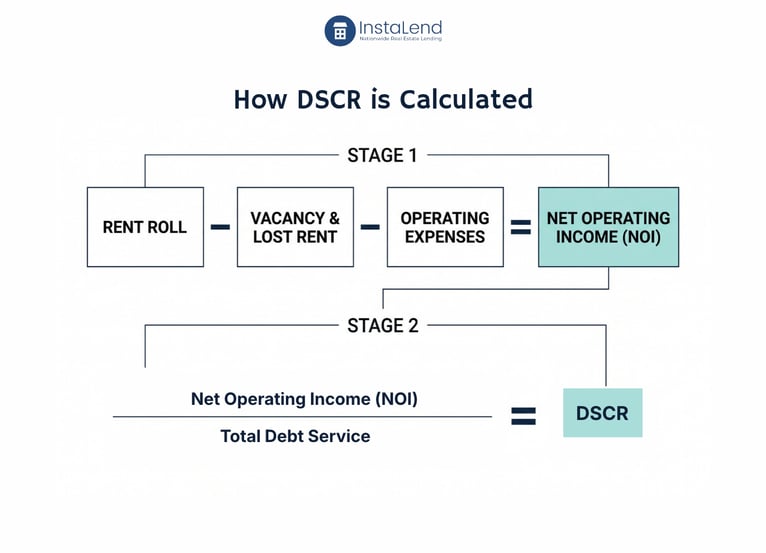
Lenders don't take a seller's listing at face value. They rebuild the building's income from the documents in four steps, then test it against the loan payment.
4.1 Lenders start with the rent roll
- Rent roll: A list of every unit, tenant, lease date and rent.
- Gross rental income: Fannie Mae uses actual rents for occupied units plus market rents for vacant units, times 12 (Fannie Mae Multifamily Guide).
- T-12: Lenders also review the trailing 12 months of income and expenses, and often several years of P&Ls (Peony, citing Multifamily.loans).
4.2 Lenders subtract vacancy and lost rent
- Vacancy factor: Even a full building gets one, because tenants turn over.
- HUD minimum: HUD 223(f) uses at least 7% underwriting vacancy for market-rate properties (Lument).
- Concessions and bad debt: Free rent and uncollected rent come off too (Fannie Mae).
- Other income: Documented laundry, parking or pet fees get added back. The result is effective gross income (EGI): what the building actually collects.
4.3 Lenders subtract operating expenses to fiind NOI
- Typical expenses: Taxes, insurance, utilities, repairs, payroll, management and replacement reserves.
- Lender adjustments: If the seller's expenses look light, lenders use their own figures. For benchmarks, see What Is a Good NOI for a Multifamily Investment Property?
4.4 Lenders check that NOI covers the loan payment (DSCR)
Here's the math for a hypothetical 20-unit building:
|
Line |
Amount |
|
Gross potential rent (20 units × $1,400 × 12) |
$336,000 |
|
Minus 5% vacancy |
−$16,800 |
|
Minus 1% concessions and bad debt |
−$3,360 |
|
Line |
Amount |
|
Plus other income |
+$6,000 |
|
Effective gross income |
$321,840 |
|
Minus operating expenses |
−$135,000 |
|
NOI |
$186,840 |
|
Max annual debt service at 1.25x DSCR |
$149,472 |
That payment cap sets the largest loan the income can support. Go deeper with DSCR requirements for multifamily loans and how NOI affects term loan qualification.
4.4.1 Rental income lenders won't count
-
Pro forma rents: Future rents tenants aren't paying yet (bridge lenders are the exception, since they look at the plan).
-
One-time income: Lease buyouts or insurance payouts.
-
Undocumented cash: Anything missing from the T-12 or bank deposits.
-
Above-market rents: Rents likely to drop when leases renew.
Income also drives how much cash you'll need: see multifamily loan down payment requirements.
5. Types of multifamily lenders and how to choose one
There's no single best multifamily lender. The best one is built for your building's condition, your timeline and your hold period.
5.1 Which type of lender is best for your deal?
|
Lender type |
Best for |
Watch out for |
|
Agency lenders (Fannie Mae DUS, Freddie Mac Optigo) |
Stabilized buildings, long holds |
Occupancy rules, 45–60 day closings, prepayment penalties |
|
HUD/FHA lenders |
Highest leverage, longest fixed terms |
Months-long approvals, heavy paperwork |
|
Banks and credit unions |
Smaller buildings, local relationships |
Personal recourse, full income documents |
|
Lender type |
Best for |
Watch out for |
|
CMBS lenders |
Larger non-recourse loans |
Rigid servicing and prepayment |
|
Life insurance companies |
Low-leverage loans on top-quality buildings |
Conservative leverage, selective on markets |
|
Private and asset-based lenders (such as InstaLend) |
Value-add and stabilized 5+ unit buildings, fast closes, no income verification |
Higher rates than agency or bank permanent debt |
5.2 Questions to ask befiore choosing a multifiamily lender
-
Do you lend on my deal? Check property type, unit count, loan size and state.
-
What occupancy and DSCR do you require? This tells you fast whether your building qualifies today.
-
How do you size the loan? LTV, DSCR or loan-to-cost can change your loan by six figures.
-
What do you need from me personally? Tax returns, net worth and experience, or just the property's numbers?
-
How fast can you close, and what are the prepayment terms? Speed wins deals; prepayment terms decide how flexible your exit is.
6. Where InstaLend fiits
InstaLend finances 5+ unit apartment buildings at both stages of the deal. Both loans are asset-based: we qualify the property's income and value, with no W-2s or tax returns.
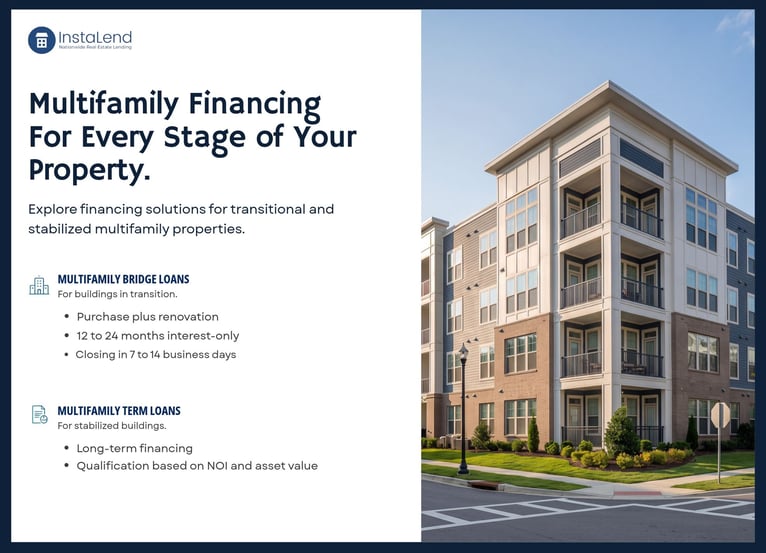
- Multifamily bridge loans: For buildings in transition. $500,000 to $10M+, up to 80% of purchase plus renovation, 12 to 24 months interest-only, closing in 7 to 14 business days (details).
- Multifamily term loans: For stabilized buildings. Long-term financing from $500,000, qualified on NOI and asset value (details).
- Track record:
 727 on the 2024 Inc. 5000 and
 99 on the FTAmericas' Fastest-Growing Companies 2025 list.
- Coverage: 46 states; not available in North Dakota, South Dakota, Arizona, California or Utah.
All loans are subject to underwriting and approval.
7. FAQs
7.1 What are typical interest rates fior a large apartment complex loan?
Heading into 2027 (rates as of mid-November 2026), large stabilized apartment loans from agency, HUD and CMBS lenders are mostly quoted around 6% to 7.5%. Larger loans often price lower: one broker's agency rates start at 6.02% over $6 million vs. 6.42% under $6 million (Select Commercial).
7.2 What are the best lenders fior buying a multifiamily building?
The best lender matches your building's condition. Agency or HUD lenders usually win for stabilized long holds; bridge lenders usually win for renovations and fast closes.
7.3 How do lenders calculate rental income when approving a multifiamily loan?
They start with the rent roll, subtract vacancy, lost rent and operating expenses to get NOI, then divide NOI by the annual loan payment. Most want a DSCR of 1.20x to 1.25x or higher.
7.4 What loan options are available fior buying a multifiamily property?
The six main options are agency, HUD/FHA, bank or credit union, CMBS, bridge and asset-based term loans. Stabilized buildings fit permanent loans; buildings needing work usually start with a bridge loan.
7.5 How does a multifiamily loan work?
The loan is secured by a 5+ unit building and repaid from its rent. The lender sizes it on the lower of the value test (LTV) and the income test (DSCR).
7.6 Do I need to verifiy my personal income to get a multifiamily loan?
It depends on the lender. Banks and agency lenders review your personal finances; asset-based lenders like InstaLend qualify the loan on the property's NOI and value instead.
8. Your step-by-step plan to fiinance a multifiamily property
Use this plan before you request a single term sheet.
-
Decide if the building is stabilized. Roughly 90% occupied with steady income points to permanent loans; anything less usually means a bridge loan first.
-
Run the income test on today's numbers. Take the rent roll down to NOI (section 4) and check it covers the payment at 1.25x.
-
Check your borrower profile. Fannie Mae Small Loans, for example, typically want net worth equal to the loan and liquid assets equal to 6 months of payments (Multifamily.loans); asset-based lenders focus on the property.
-
Build your deal package. Gather the rent roll, T-12, recent P&Ls, photos and any renovation budget, plus a personal financial statement and real estate schedule if the lender asks.
-
Compare term sheets, not just rates. Line up prepayment terms, interest-only periods, reserves, fees and extension options side by side.
-
Stress-test your exit. If you're using a bridge loan, check that the refinance still works at a rate 0.75 to 1 point above today's; see exit strategies for bridge financing.
-
Clear third-party reports and close. Expect an appraisal, Phase I environmental review and property condition report (Apartment Loan Store); agency loans often take 45 to 60 days, while InstaLend bridge loans close in 7 to 14 business days.
Get your quote. Send InstaLend your property address, unit count and rent roll for a fast answer
Sources
-
-
Select Commercial, commercial mortgage rates, Nov. 13, 2026 and multifamily loan rates, Nov. 6, 2026
-
Apartment Loan Store, multifamily loan rates, Nov. 13, 2026
-
Commercial Loan Direct, apartment loan rates, Nov. 13, 2026
-
CommLoan, commercial mortgage rates, Nov. 13, 2026
-
YCharts, 10-year Treasury rate
-
NewPoint, HUD/FHA 223(f) term sheet; HUD.loans, 223(f) vs. 221(d)(4); Lument, FHA 223(f) term sheet, June 2026
-
Fannie Mae Multifamily Guide, underwriting income form and vacancy and concessions
-
Peony, apartment building deal room (citing Multifamily.loans on T-12 and P&L requests)
-
InstaLend: bridge loan page, term loan page, homepage, How to Finance an Apartment Building With a Bridge Loan (state list)
-
Arbor, FHFA loan caps for 2026 (50% mission-driven requirement)
-
FRC Capital, Multifamily financing options in 2026 (HUD 223(f) closing timeline)
-
Multifamily.loans, Fannie Mae Small Loans ($1M to $9M)
-
MBA, 17% of commercial and multifamily mortgage balances to mature in 2026 ($875B)
-
 Apartment Loan Store, Fannie Mae multifamily guidelines (required third-party reports)